
 Fashion-Enter Ltd and its educational arm Fashion Technology Academy (FTA) was delighted to welcome Neeraj Sharma (pictured right), founder of WeAreDaisyChain, to its recent industry meeting at the Palace of Westminster on 16th September, co-hosted with Fashion-Enter Ltd. The meeting brought together representatives from across the UK garment and textile manufacturing sector, alongside organisations supporting the industry’s future. Discussions focused on skills development, training, public procurement and the need to build a stronger and more resilient domestic manufacturing base.
Neeraj’s contribution brought another important dimension to those discussions: how can we make training and education more inclusive so that more people can develop the skills needed to participate in the fashion and textile industry?
For FTA, this is an increasingly important question. If the sector is to address its skills challenges and develop the workforce of the future, inclusion cannot begin only when someone enters employment. It needs to start much earlier — in education, training, skills development and the pathways that connect learners with industry.
Neeraj’s work with WeAreDaisyChain began with a practical challenge. Daisy Chain receives around 2,000 bags of donated textiles every week, yet only approximately one-third of these donations are suitable for conventional resale. Rather than viewing the remaining material simply as waste, Neeraj saw an opportunity to create something new through Neuthread, a neurodivergent-led circular fashion enterprise designed to transform textile waste into high-value British fashion. The initiative demonstrates what can happen when people are given the opportunity to develop practical skills in a real manufacturing environment. But the wider lesson extends beyond circular fashion. It raises an important question for educators and training providers: how many people have skills and capabilities that remain undiscovered because traditional education and training environments do not provide the right conditions for them to demonstrate those abilities?
For the fashion and textile sector, this matters. Manufacturing requires a diverse range of practical, technical, creative and organisational skills. Learners do not all acquire or demonstrate those skills in the same way. Creating genuinely inclusive training means recognising those differences rather than expecting every learner to follow exactly the same route. Neeraj’s Churchill Fellowship gave him the opportunity to explore inclusive employment and manufacturing models internationally, including visits to organisations across the United States. One of the key lessons was that successful models did not simply provide support around employment. They connected people with real skills, real machinery, real production and real commercial requirements.
One of the most striking examples Neeraj shared was that of Kendrick, whom he met during his Fellowship. Kendrick had never used a sewing machine before joining the organisation. With exposure, training and technical development, he progressed to operating highly specialist cutting equipment — equipment for which the company had previously struggled to recruit externally. The lesson is significant for both employers and educators. A learner who struggles within one learning environment may thrive within another. Someone who finds a conventional classroom challenging may demonstrate exceptional concentration, technical ability, creativity or problem-solving when working with machinery or practical tasks.
This does not mean lowering expectations. It means considering whether the way skills are taught and assessed allows every learner to demonstrate what they can do. For FTA, this highlights the importance of bringing education and industry closer together. Training becomes more meaningful when learners understand where their skills are leading. Rather than treating education and employment as two separate stages, there is an opportunity to create stronger connections between the training environment and the workplace.
Manufacturers understand the practical realities of production. They know the machinery, processes and standards that future employees need to understand. Education and training providers, meanwhile, understand how different learners acquire and demonstrate skills. Bringing those perspectives together can create clearer pathways from learning into employment, apprenticeships, further education and progression. It can also help employers look beyond conventional recruitment criteria and recognise potential that may otherwise be overlooked.
Differentiated learning does not necessarily mean creating an entirely separate system for every learner. It can mean providing different routes to the same objective: adapting communication, using practical demonstrations, allowing additional processing time, providing visual instructions or creating learning environments where learners can develop confidence alongside technical competence. These approaches can benefit neurodivergent and disabled learners, but they can also improve learning for many others. The objective is not to create a separate workforce. It is to create more accessible routes into the same industry. For FTA, this is particularly relevant as the fashion and textile sector faces ongoing skills shortages alongside rapid technological change, sustainability requirements and the need to strengthen domestic manufacturing.
Developing the workforce therefore requires more than increasing training places. It requires consideration of who can access those opportunities, how training is delivered and whether learners are given the support they need to realise their potential.
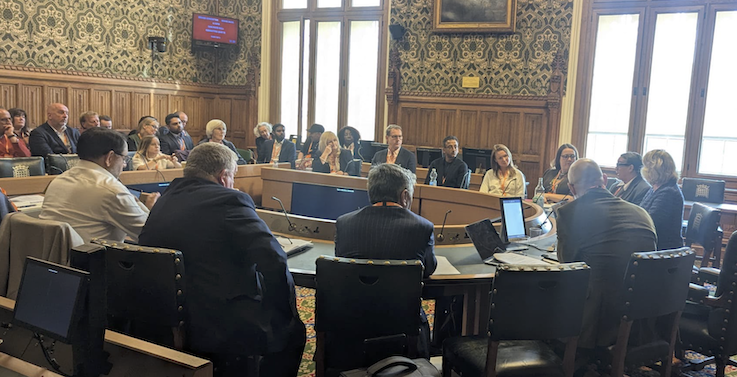
(Industry meeting at the Palace of Westminster on 16th September)
Jenny Holloway, CEO of Fashion-Enter Ltd, said: “It was an opportunity that WeAreDaisyChain created when they contacted Fashion-Enter independently. The sustainability aspects of WeAreDaisyChain align perfectly with Fashion-Enter, and meeting Neeraj in person proved without doubt the importance of neurodivergent provision within education.
“It is an opportune time, as the All-Party Parliamentary Group work has asked us to look deeper into differentiated learning plans for all levels of learners. The resulting work that Neeraj undertook as a Churchill Fellow proved without doubt that every learner has the right skills to be part of the manufacturing process.”
Neeraj’s Churchill Fellowship report is now in its final stages of referencing and publication preparation and will provide a more detailed account of his research, recommendations and proposed NeuSemble model. FTA looks forward to continuing the conversation with WeAreDaisyChain and exploring how these ideas can contribute to wider discussions around skills, education and inclusion within the UK fashion and textile industry.